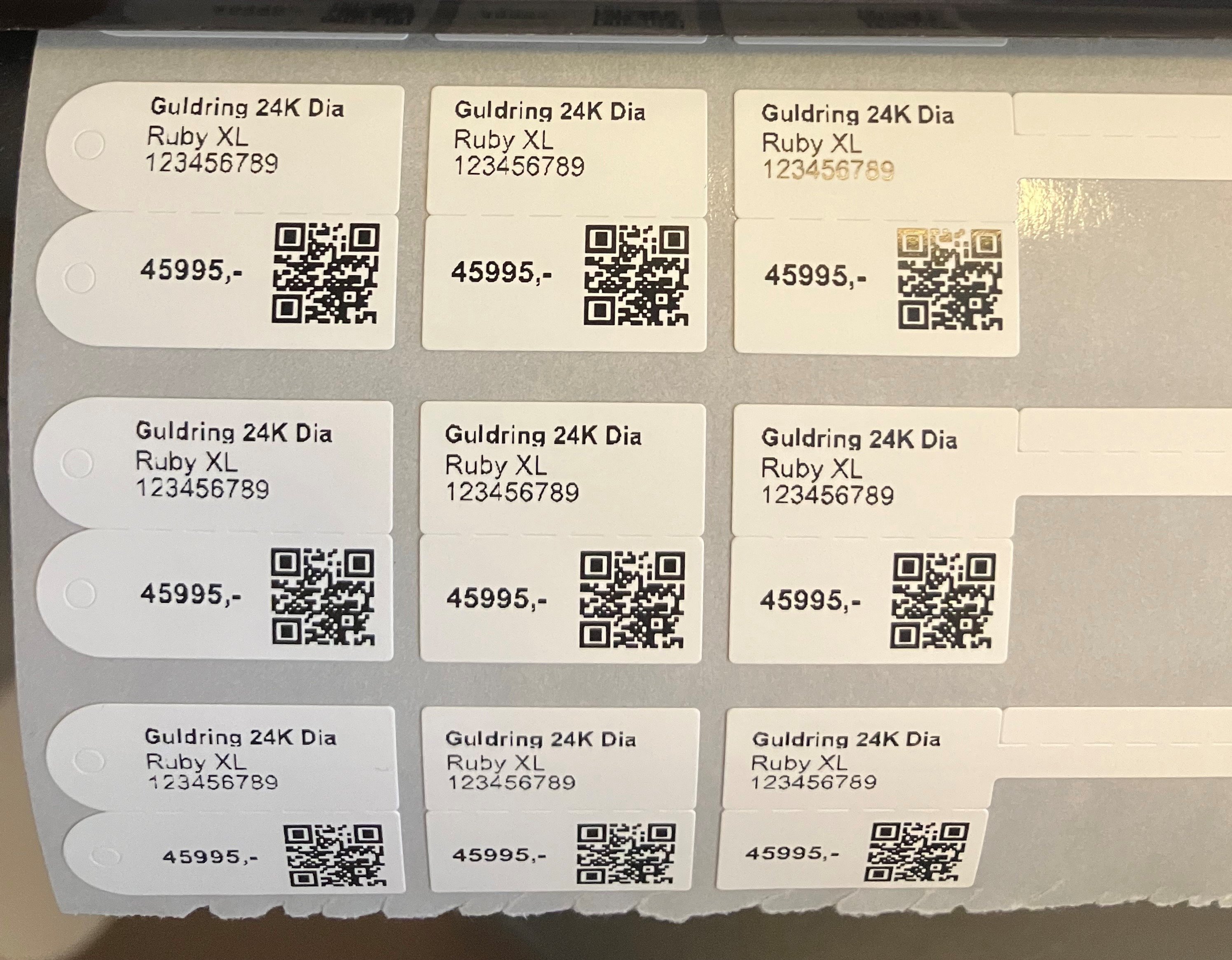
This guide will walk you through the setup and configuration of our Jewelry label printer (Model TSC TC300).
Make sure you have the following at hand before you begin the setup:
A Windows computer (10/11)
One available USB port.
TSC TC300 Printer with power supply and USB cable.
Have Printdesk installed
Download the full product manual here.
The printer must be connected to power using the included 24V power supply.
Additionally, the printer must be connected with the included USB printer cable, which is connected directly to the back of the printer and to your computer's USB port
The printer can also be connected via the network port on the back of the printer, so it can be used on multiple computers, but this is outside the scope of this guide and is at your own risk! We do not help with configuring this.
Port overview (from left to right)
LAN Port (RJ-45)
USB 2.0 (type B)
Parallel port (not used)
Serial port, RS232 (not used)
24V DC Power input
Power switch (main switch)
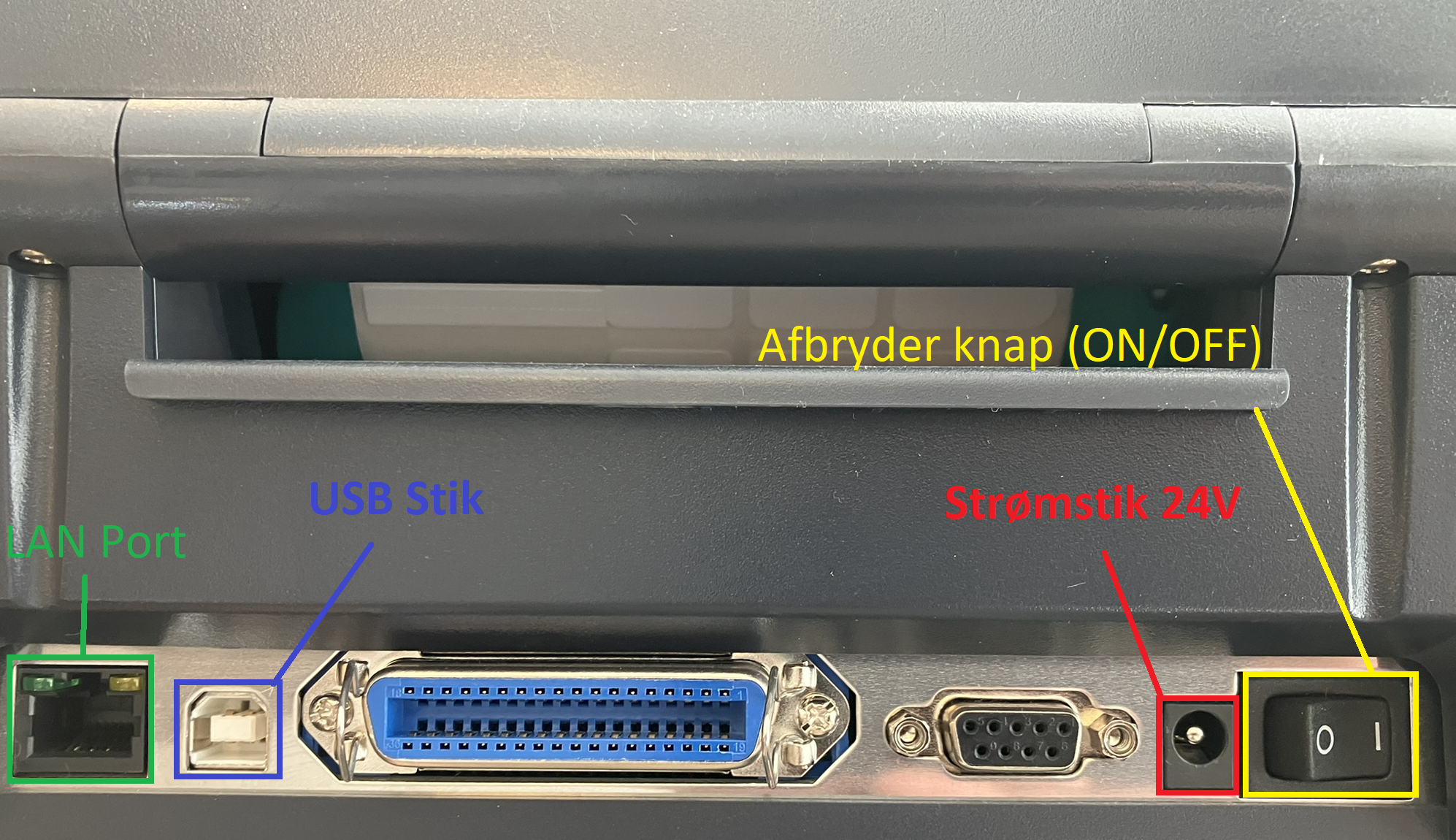
In this case, we simply connect the printer with the included USB cable.
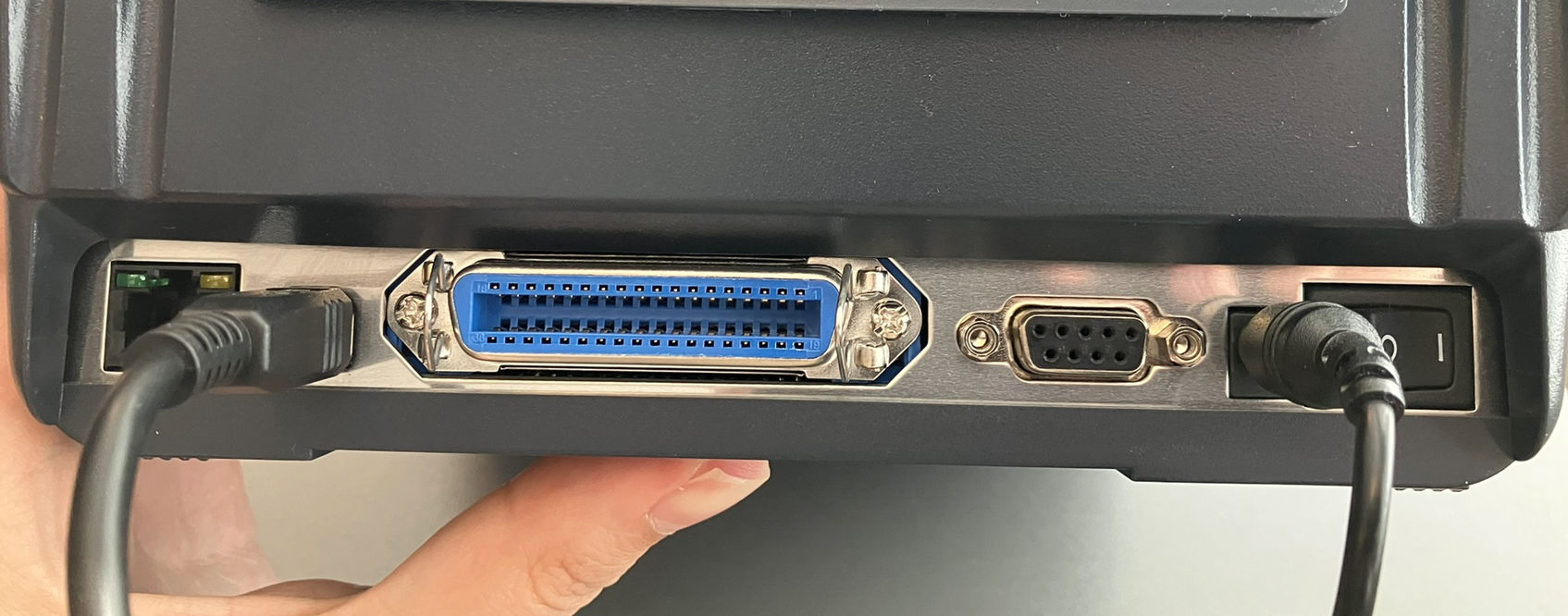
It is also possible to connect the printer via the network (LAN). You simply need to connect a LAN cable from your router to the printer's LAN port (RJ-45 port) on the back.
Before you can set up the printer to run via LAN, it must be connected for the first time using USB and then a program must be run that sets the printer to run in network mode, so it receives an IP address.
NB: Only connect the printer with a LAN cable if you have a reasonable understanding of how networks and IP addresses work.
Download TSC Diagtool (Official site)
Download TSC Diagtool (Backup link)
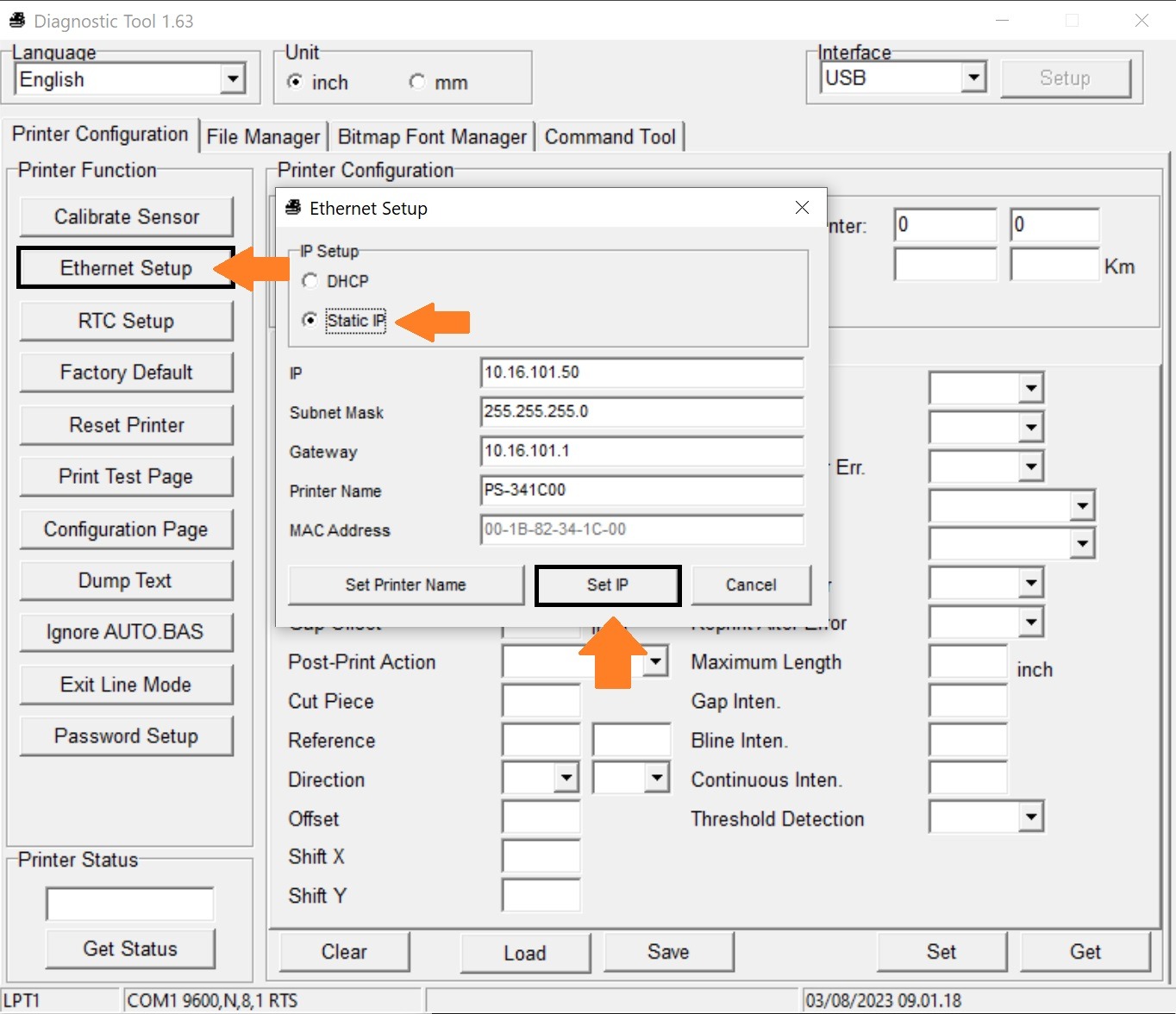
Open DiagTool.exe as administrator.
Set the language to English, if it is not already automatically selected.
Click on Ethernet setup on the left.
In the dialog box, select Static IP.
Then you need to fill in IP information that matches your scope in your local network. (The printer's IP should of course be one that is not already in use!)
Once you have entered the correct IP, subnet mask and gateway, you can click Set.
Before the printer can be used, the necessary printer driver must be installed.
Please note that this printer only works on Windows computers running Windows 10 64-bit or newer.
TSC TC300 Printer Driver (Official Site)
The printer driver can also be downloaded from our backup link (Backup)
Make sure to connect the printer with the included USB cable and turn on the device before you start installing the printer driver.
Then follow the instructions on the installation as indicated by the installation program.
When the driver installation is complete, restart your computer and possibly reinsert your USB cable to the printer, and then it should appear in your Windows printer list with the name 'TSC-TC300'
Special jewelry labels and a type of carbon paper must be used for this type of printer, which can be ordered via our webshop.
Open the printer by pressing the two side buttons towards you at the same time, so the top unlocks and can be lifted.
Then you can insert your label roll onto the holder by pushing the holder's arm to the side so there is room for the label roll and it can be mounted on it in the roll's hole. *Marked in yellow*
Pull the end of the roll out of the printer so it hits the rubber roller at the front. *Marked in purple*
Make sure the sides of the label roll are between the adjustable holder which can be loosened/tightened on the wheel to the right. *Marked in orange*
This ensures that the label roll does not run out skewed, but is kept in a straight line all the way.
Adjust the label sensor so that it is safely in the middle under your label. *Marked in green*
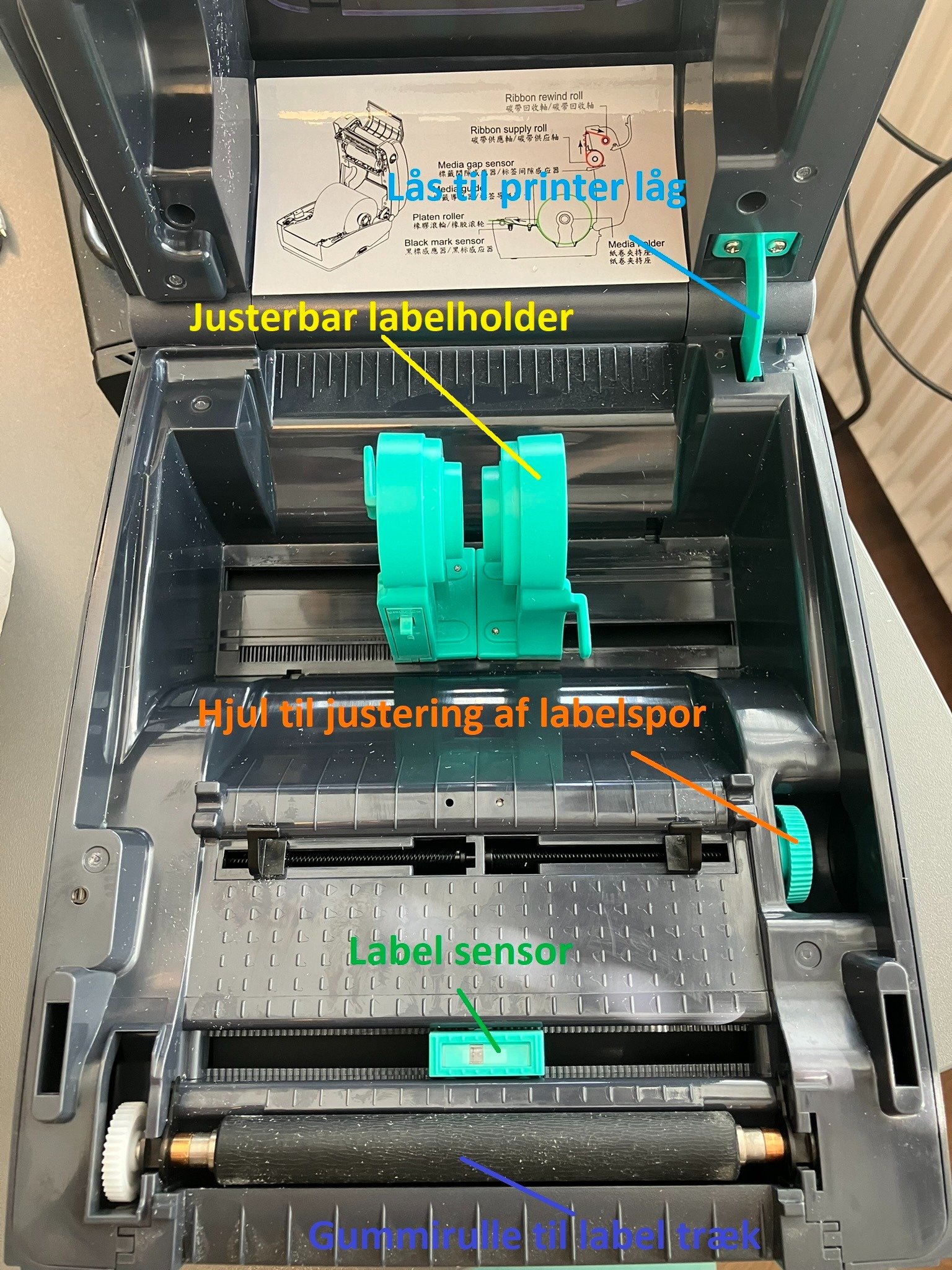
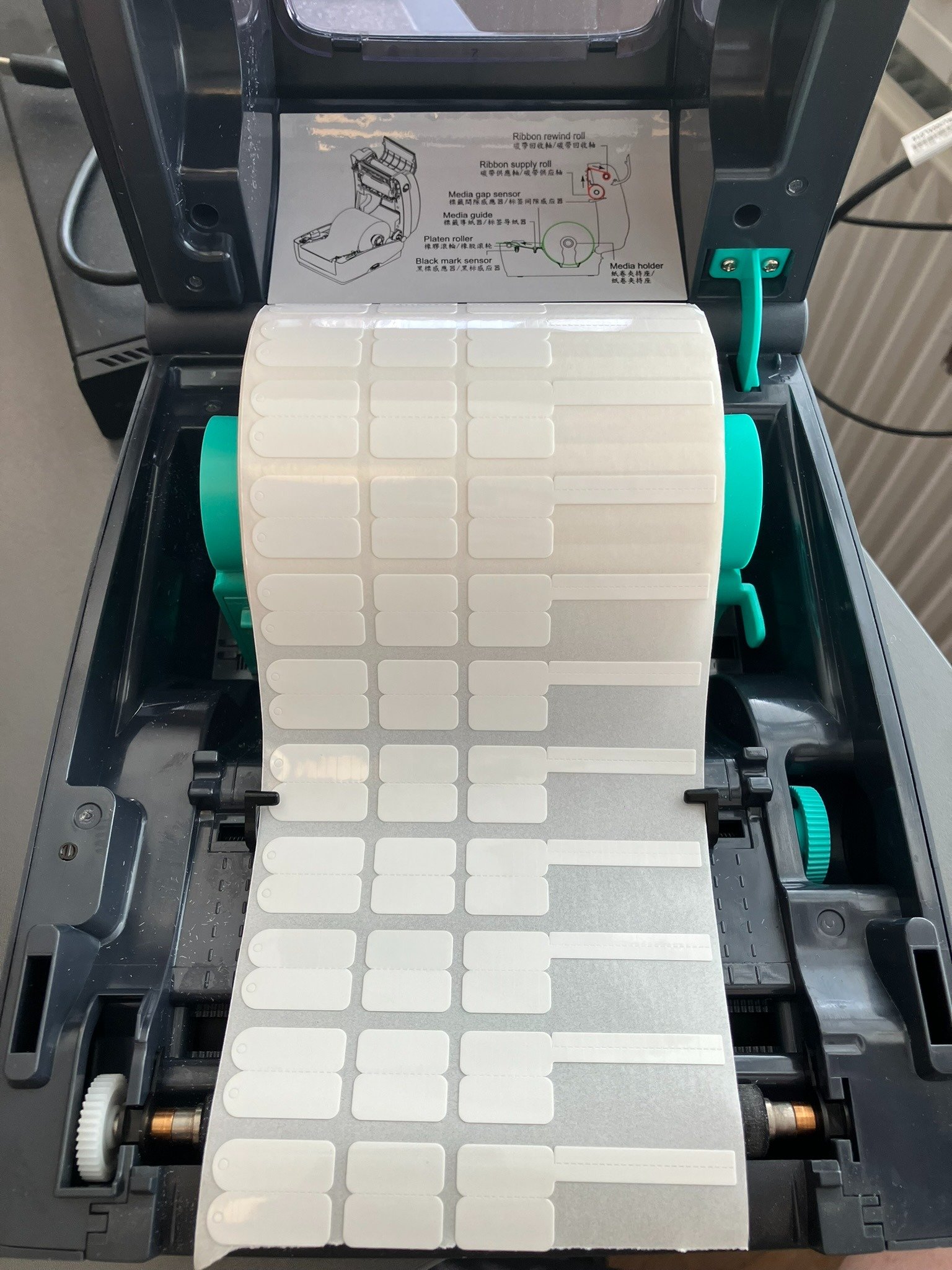
This video from TSC can be used as a guide - however, it does not show the type of labels used for jewelry in the video, but the procedure is largely the same.
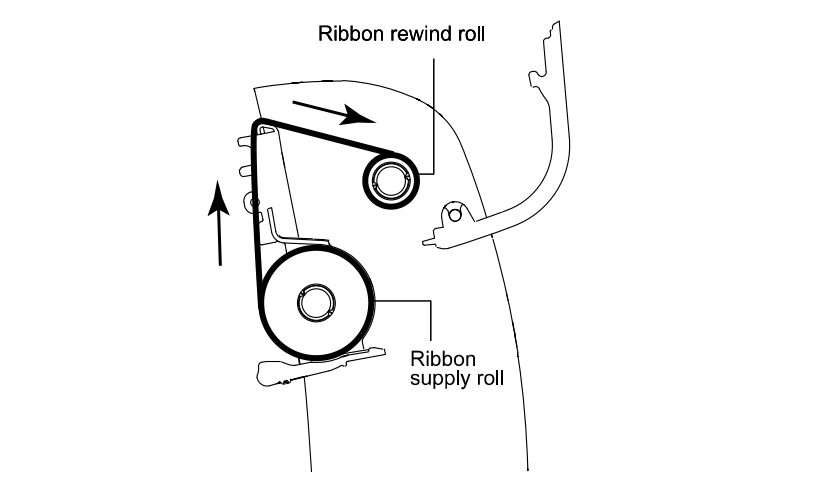
When the printer's top is open, you can open the top shield that sits against the front.
Here you mount the included empty cardboard roll which is used to wind up the used carbon paper. The holder is spring-loaded so you need to press it slightly to the right to make room for the roll. After that, you can rotate the roll until it sits in tension on the holder and rotates with the holder correctly.
After that, you can open your new roll of carbon paper and secure it on the bottom spool holder, which is located just below and is accessible from the inside of the printer.
For additional images and further details, refer to the printer's manual pages 24-26.
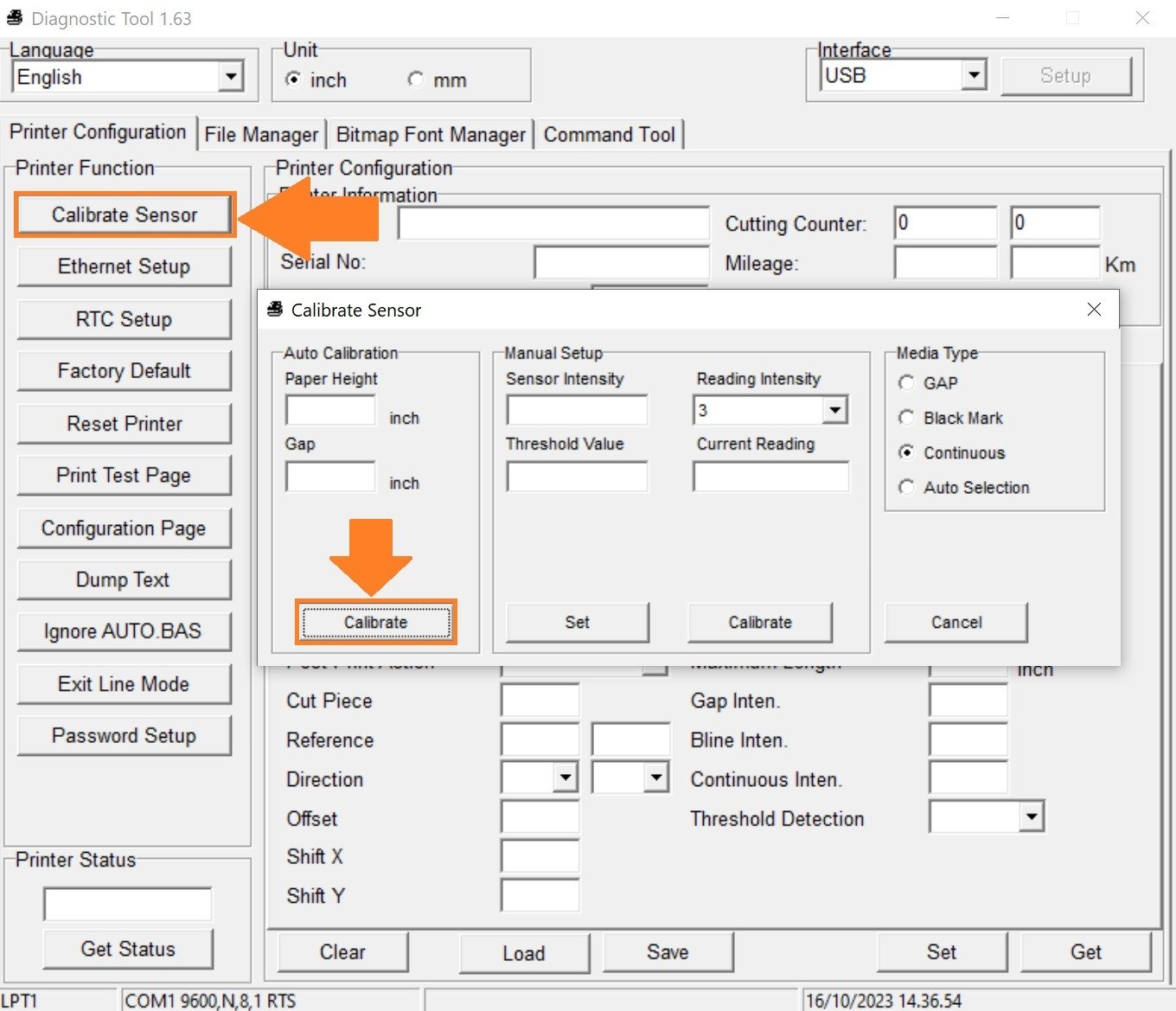
The first time you set up the printer on your device, you need to perform an extended calibration to ensure the printer understands what type of label is inserted and its size.
This is also done via TSC's DiagTool:
Open DiagTool.exe as administrator.
Set Unit to mm. (Metric measurement) at the top.
Select Calibrate Sensor on the left.
Click the Calibrate-button and the printer calibration begins. You do not need to enter anything in the fields during this process, as the printer measures the size in mm itself.
The printer runs labels back and forth and uses approximately 4-7 rows of labels for this, which are printed not on the labels.
When the printer is done, this tool can be closed again.
It is important that you calibrate the printer every time you replace the label and or carbon ribbon to ensure it still stands and prints correctly.
However, you don't always need to use DiagTool for this, as in most cases you can get by with a basic calibration that can be activated directly on the printer:
Perform a basic calibration:
Turn off the printer using the switch on the back of the printer (Set to 0)
Hold down the Feed button on the printer while you turn it back on from the back (Round button to the left of the LED indicator)
Wait for the printer to change from Orange to Red light and count 5 red flashes before you release the feed button again.
After that, the printer will perform a basic calibration.

NB: If the printer does not calibrate and spits out blank labels, you released the feed button too late and should therefore start over. No printing occurs on the labels during calibration.
Before you can print correctly on the labels from C 1ST, the label dimensions must be specified in the printer's driver to tell Windows what size/format is being printed on.
Open Printers and Scanners in Windows.
Locate the printer in the list (by default it is called TSC TC300)
Click Manage under the printer.
Select Print settings from the menu items.
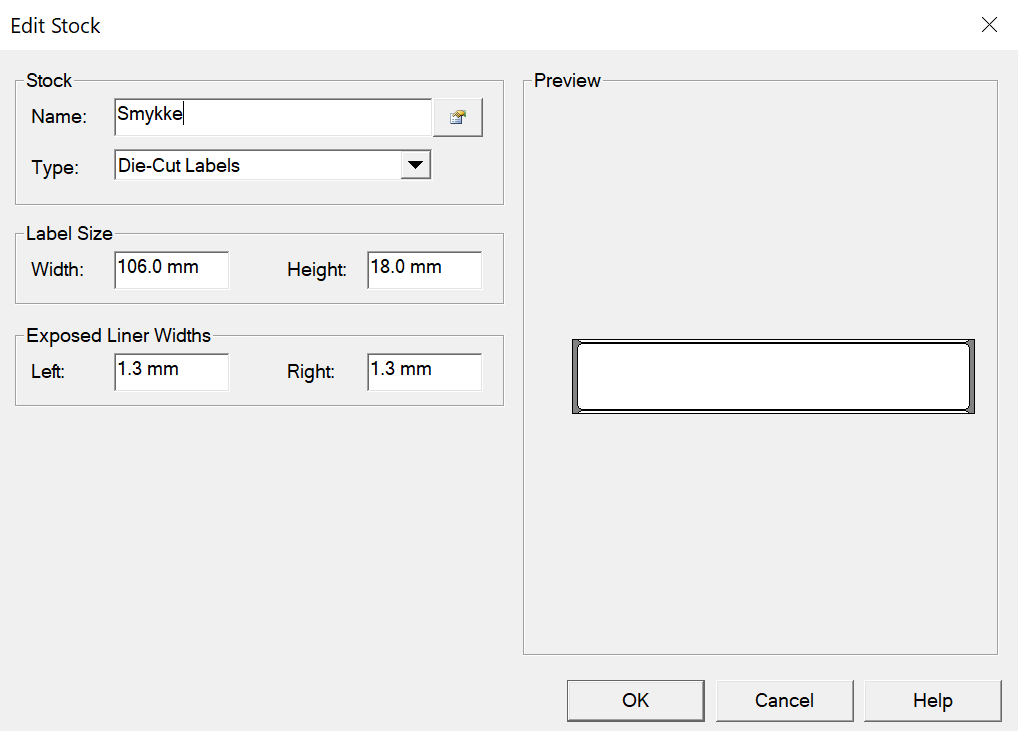
Under Stock click New and create a new template type.
Name it 'Jewelry' and set the following information*
Label Size Width: 106 mm.*
Label Size Height: 18 mm.*
*Depends on your label but this applies to our type.
You should not change anything else here.
Click OK to save.
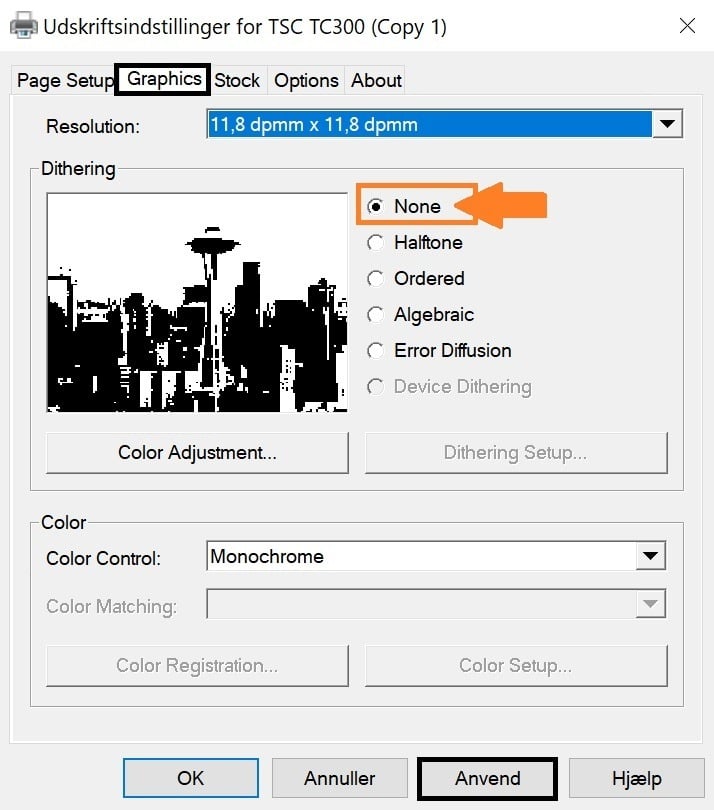
The following settings must be configured under the Graphics section in the driver. Click Apply to save.
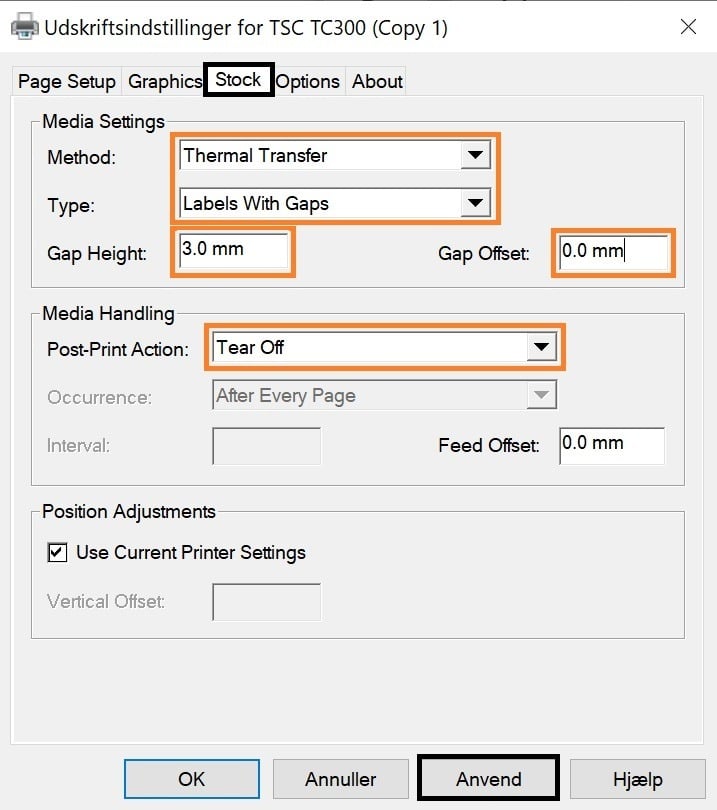
The following settings must be configured under the Stock section in the driver. Click Apply to save.
Method: Thermal Transfer
Type: Labels With Gaps
Gap Height: 3 mm.*
Gab Offset: 0 mm.
Post-Print Action: Tear Off
*May vary depending on different labels. Measure yourself afterwards.
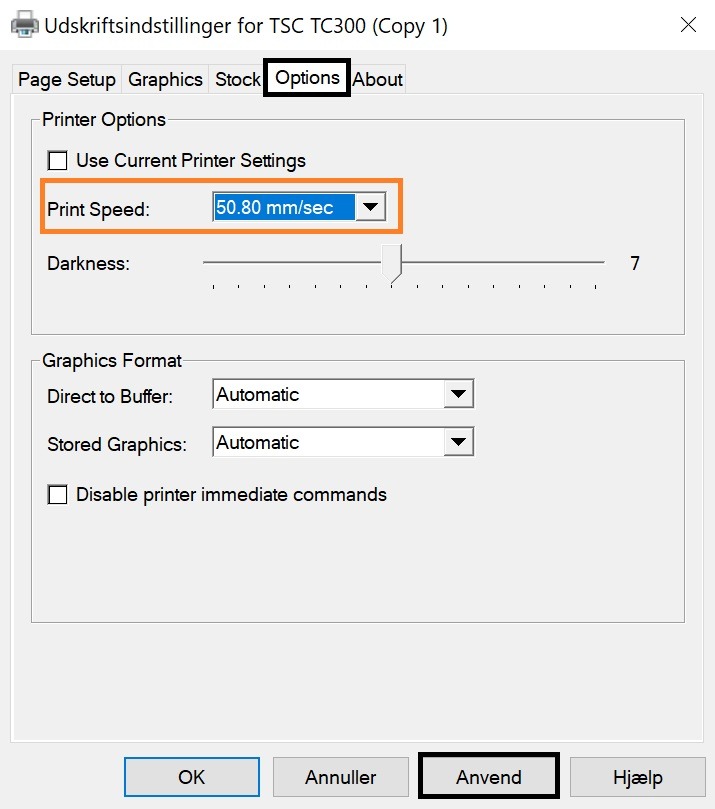
The following settings must be configured under the Options section in the driver. Click Apply to save.
Print Speed: 50.80 mm/sec
Darkness: Leave at default (7) and only adjust if the print is not clear enough.
Log in to your C 1ST app on your computer and navigate to Settings -> Print.
Under the Price Label section, select your TSC TC300 label printer.
If you cannot see your label printer in the dropdown list, make sure you have installed our print client. Get help installing Printdesk here.
Enter the following:
Margin: No margin
Size: Special
Width: 106 mm.
Length (Height): 18 mm.
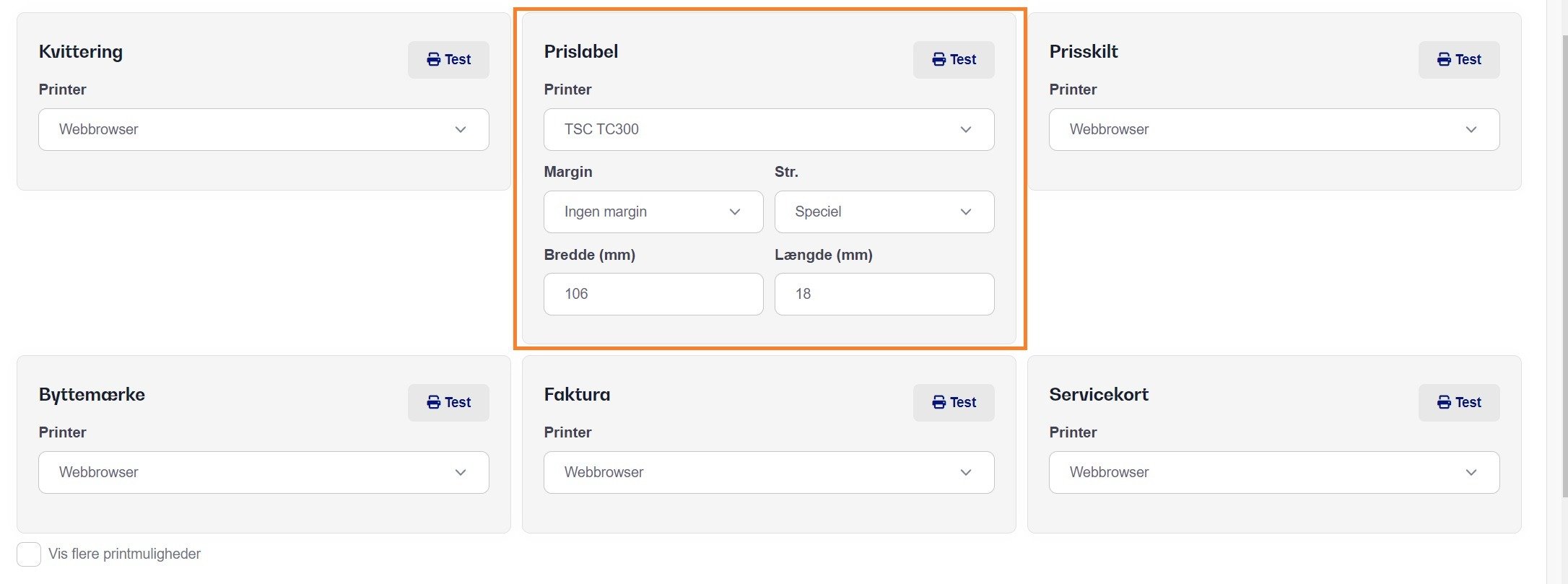
NB: These settings are only saved locally on your device, so if you set up your printer for LAN to be able to print from multiple computers, this needs to be repeated for each device.
In most cases you would need to adjust and offset the print slightly so it hits precisely on your label and is perfectly straight.
This is done under the print settings and by clicking the Advanced Options button.
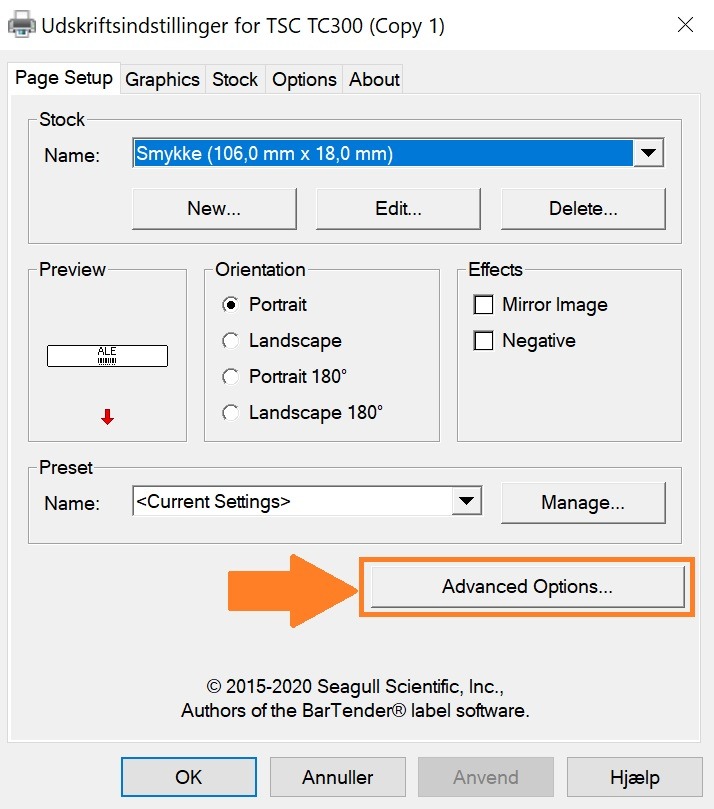
Here you will typically need to use trial-and-error to find the perfect adjustments, as this varies a lot. In my case, I found that Horizontal Offset is set to 6.5 mm. and Vertical Offset is set to 1 mm.
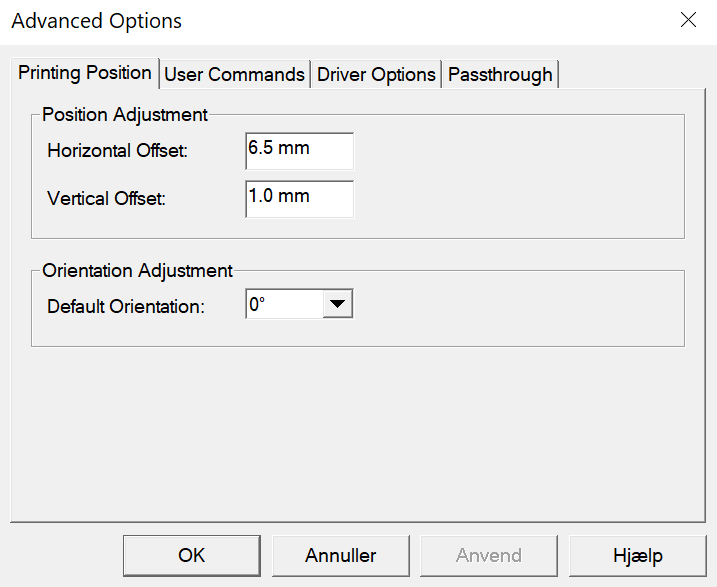
You may need to adjust 1 mm. at a time and then save and print a new label from C 1ST to see the result of your change.
There are two types of templates for our jewelry labels:
Jewelry label with QR code (Recommended)
Jewelry label with standard barcode (Supports maximum 8-digit barcode)
The code should simply be inserted on the template Pricelabel under our print templates.
<html>

  <head>
    <meta http-equiv="content-type" content="text/html; charset=UTF-8">
    <title>Jewelry label</title>
    <style type="text/css">
      body,
      h1,
      h2,
      td,
      p {
        font-family: Arial;
      }

      body {
        font-size: 2mm;
        /*width: 105mm;
        height: 18mm;*/
        margin: 0px;
      }

      p {
        margin-bottom: 0px;
        margin-top: 0px;
      }

      * {
        font-smooth: never;
      }

      .top {
        float: left;
        width: 100%;
        margin-top: 0mm;
      }

      .bottom {
        float: left;
        width: 100%;
        margin-top: 0mm;
      }

      p.limitText {
        white-space: nowrap;
        overflow: hidden;
        text-overflow: ellipsis;
        max-width: 18mm;
        margin: 0px;
        font-weight: bold;
        margin-bottom: 1px;
      }

      .top p,
      p.limitText span {
        font-size: 90%;
      }

      .bottom .left {
        width: 40%;
        float: left;
        text-align: center;
        margin-top: 3mm;
      }

      .bottom .right {
        width: 60%;
        float: right;
        text-align: center;
        margin-top: 0mm;
      }

      #first {
        width: 18mm;
        float: left;
        margin-left: 6mm;
      }

      #second {
        width: 18mm;
        float: left;
        margin-left: 2.5mm;
      }

      #third {
        width: 18mm;
        float: left;
        margin-left: 3mm;
      }

      .bottom,
      .top {
        height: 8mm;
      }

      br {
        margin: 1px 0px;
      }

      @page {
        margin: 0mm;
      }
    </style>
  </head>

  <body>
    <div id="first">
      <div class="top">
        <p class="limitText"><span>{{title}}</span></p>
        <p>{{color}} {{size}} {{#each productFiels}} {{value}}{{/each}}</p>
        <p>{{productno}}</p>
      </div>
      <div class="bottom">
        <div class="left"> <strong><span style="font-size: 100%;">{{price}},-</span></strong> </div>
        <div class="right"> {{qrsvg barcode 34 34}} </div>
      </div>
    </div>
    <div id="second">
      <div class="top">
        <p class="limitText"><span>{{title}}</span></p>
        <p>{{color}} {{size}} {{#each productFiels}} {{value}}{{/each}}</p>
        <p>{{productno}}</p>
      </div>
      <div class="bottom">
        <div class="left"><strong><span style="font-size: 100%;">{{price}},-</span></strong> </div>
        <div class="right"> {{qrsvg barcode 34 34}} </div>
      </div>
    </div>
    <div id="third">
      <div class="top">
        <p class="limitText"><span>{{title}}</span></p>
        <p>{{color}} {{size}} {{#each productFiels}} {{value}}{{/each}}</p>
        <p>{{productno}}</p>
      </div>
      <div class="bottom">
        <div class="left"><strong><span style="font-size: 100%;">{{price}},-</span></strong> </div>
        <div class="right"> {{qrsvg barcode 34 34}} </div>
      </div>

    </div>
  </body>

</html>
Coming soon!
When you print your jewelry labels, all content should be visible and we recommend there is 0.5-1mm. white space around the QR code to ensure optimal scanning.
NB: Remember to test your (QR) barcodes with your scanner to make sure they can be scanned easily. If all settings are configured correctly, it should be quick to read the codes on the labels.
Remember that a 2D-compatible barcode scanner is required to read QR codes.
If you don't have one yet, you can buy one through our webshop.